 Add to Chrome
 Add to Firefox
 Add to Edge
RUBRIC-ARROW: Alternating Pointwise Rubric Reward Modeling for LLM Post-training in Non-verifiable Domains
May 27, 2026
Pointwise reward modeling offers critical signals for LLM post-training, yet struggles with absolute scoring in subjective, non-verifiable settings. Rubric-based methods address this by decomposing evaluation into explicit criteria, but existing approaches typically depend on frontier LLMs and suffer from ties caused by hard Boolean aggregation. We present RUBRIC-ARROW, an alternating framework that jointly trains a rubric generator and a rubric-conditioned judge, with its RL stage using only pairwise preference data. Our method couples a probability-based scoring rule that reduces ties with phase-specific preference-based rewards and an alternating GRPO scheme that together train the pointwise evaluator. Extensive experiments show that RUBRIC-ARROW achieves competitive reward-modeling accuracy and yields consistent gains for downstream policy post-training.

AutoResearch AI: Towards AI-Powered Research Automation for Scientific Discovery
May 22, 2026Scientific research is being reshaped by AI systems that move beyond isolated assistance toward longer-horizon workflows spanning literature grounding, hypothesis generation, experimentation, validation, reporting, and revision. This shift marks a transition from task-level AI for science to workflow-level research automation. Yet current systems remain fragmented, differing in autonomy, domain scope, execution environment, validation mechanism, and human oversight, while still struggling with evidence preservation, reproducibility, weak-direction rejection, provenance tracking, cross-domain robustness, and accountable scientific closure. This survey examines these developments through AutoResearch, defined as the developmental spectrum of AI-powered scientific workflow automation. Within it, Vibe Research denotes the human-steered region of prompt-based assistance and human-verified execution, whereas emerging AI-led systems coordinate larger portions of the discovery loop without achieving robust autonomy. We analyze how research systems redistribute control, evidence, execution, validation, and accountability across workflows and organize the field around five workflow conditions: literature and research grounding; hypothesis formation and planning; experimentation and tool use; feedback, validation, and review; and reporting and knowledge communication. We further synthesize AI scientist systems, mixed-initiative co-research frameworks, benchmarks, domain deployments, and open-source infrastructures. Finally, we propose five evaluation dimensions--novelty, validity, impact, reliability, and provenance--and show that AutoResearch autonomy is domain-conditioned, being more credible in structured, executable, and rapidly verifiable settings but limited in embodied, delayed, heterogeneous, ethical, or institutionally accountable contexts.
Towards Camera-Robust 3D Localization: Equation-Anchored Tool-Use for MLLMs
May 19, 20263D localization in Multimodal Large Language Models (MLLMs), including 3D object detection and 3D visual grounding, is fundamentally limited by camera intrinsic ambiguity: the same image admits different 3D scenes under different cameras. Existing MLLMs either ignore camera parameters and overfit to a canonical training intrinsic, or retrieve depth and 3D cues from external tools but treat the returned values as reference cues (numerical hints that the model is free to interpret implicitly), both preventing camera information from being deterministically propagated into the prediction. We propose an equation-anchored tool-use framework that re-purposes spatial tools as formula variables. The proposed framework proactively retrieves camera intrinsics and samples multi-point metric depths, writes the pinhole back-projection equation $\hat{X} = (u_c - c_x)\bar{Z}/f_x$ explicitly in Chain-of-Thought (CoT), and substitutes tool outputs into the formula before regressing the final 9-DoF bounding box. On both 3D object detection and 3D visual grounding tasks under rescaled camera intrinsics from $0.5\times$ to $1.5\times$, our method outperforms RGB-only and tool-augmented baselines, with significant gains where the camera deviates most from the training scale. Code and data will be released.
VLAA-GUI: Knowing When to Stop, Recover, and Search, A Modular Framework for GUI Automation
Apr 23, 2026Autonomous GUI agents face two fundamental challenges: early stopping, where agents prematurely declare success without verifiable evidence, and repetitive loops, where agents cycle through the same failing actions without recovery. We present VLAA-GUI, a modular GUI agentic framework built around three integrated components that guide the system on when to Stop, Recover, and Search. First, a mandatory Completeness Verifier enforces UI-observable success criteria and verification at every finish step -- with an agent-level verifier that cross-examines completion claims with decision rules, rejecting those lacking direct visual evidence. Second, a mandatory Loop Breaker provides multi-tier filtering: switching interaction mode after repeated failures, forcing strategy changes after persistent screen-state recurrence, and binding reflection signals to strategy shifts. Third, an on-demand Search Agent searches online for unfamiliar workflows by directly querying a capable LLM with search ability, returning results as plain text. We additionally integrate a Coding Agent for code-intensive actions and a Grounding Agent for precise action grounding, both invoked on demand when required. We evaluate VLAA-GUI across five top-tier backbones, including Opus 4.5, 4.6 and Gemini 3.1 Pro, on two benchmarks with Linux and Windows tasks, achieving top performance on both (77.5% on OSWorld and 61.0% on WindowsAgentArena). Notably, three of the five backbones surpass human performance (72.4%) on OSWorld in a single pass. Ablation studies show that all three proposed components consistently improve a strong backbone, while a weaker backbone benefits more from these tools when the step budget is sufficient. Further analysis also shows that the Loop Breaker nearly halves wasted steps for loop-prone models.
MTA-Agent: An Open Recipe for Multimodal Deep Search Agents
Apr 07, 2026Multimodal large language models (MLLMs) have demonstrated strong capabilities in visual understanding, yet they remain limited in complex, multi-step reasoning that requires deep searching and integrating visual evidence with external knowledge. In this work, we address this challenge by constructing high-quality, verified multi-hop vision-language training data for multimodal deep-search agents. We propose a Multi-hop Tool-Augmented Agent for Evidence-based QA Synthesis (MTA-Agent), which automatically selects tools and their parameters to retrieve and validate evidence from both visual and textual sources and generates structured multi-hop question-answer trajectories. Starting from diverse VQA seed datasets, our pipeline produces a large-scale training dataset, MTA-Vision-DeepSearch, containing 21K high-quality multi-hop examples. The data is filtered through a multi-stage verification process to ensure factual consistency and answer uniqueness. Using MTA-Vision-DeepSearch, a 32B open-source multimodal search agent achieves state-of-the-art performance, reaching an average of 54.63\% across six challenging benchmarks, outperforming GPT-5 (51.86\%), Gemini-2.5-Pro (50.98\%), and Gemini-3-Pro (54.46\%) under the same tool settings. We further show that training on our data improves both reasoning depth and tool-use behavior, increasing the average number of steps from 2.27 to 4.28, and leading to more systematic and persistent search strategies. Additionally, we demonstrate that training can be performed without real-time tool calls by replaying cached interactions, significantly reducing training cost. Importantly, we present MTA-Agent as a fully open recipe for multimodal deep search: we release the entire dataset, training trajectories, and implementation details to enable reproducibility and future research on open multimodal search agents.
How Far Are Vision-Language Models from Constructing the Real World? A Benchmark for Physical Generative Reasoning
Mar 25, 2026The physical world is not merely visual; it is governed by rigorous structural and procedural constraints. Yet, the evaluation of vision-language models (VLMs) remains heavily skewed toward perceptual realism, prioritizing the generation of visually plausible 3D layouts, shapes, and appearances. Current benchmarks rarely test whether models grasp the step-by-step processes and physical dependencies required to actually build these artifacts, a capability essential for automating design-to-construction pipelines. To address this, we introduce DreamHouse, a novel benchmark for physical generative reasoning: the capacity to synthesize artifacts that concurrently satisfy geometric, structural, constructability, and code-compliance constraints. We ground this benchmark in residential timber-frame construction, a domain with fully codified engineering standards and objectively verifiable correctness. We curate over 26,000 structures spanning 13 architectural styles, ach verified to construction-document standards (LOD 350) and develop a deterministic 10-test structural validation framework. Unlike static benchmarks that assess only final outputs, DreamHouse supports iterative agentic interaction. Models observe intermediate build states, generate construction actions, and receive structured environmental feedback, enabling a fine-grained evaluation of planning, structural reasoning, and self-correction. Extensive experiments with state-of-the-art VLMs reveal substantial capability gaps that are largely invisible on existing leaderboards. These findings establish physical validity as a critical evaluation axis orthogonal to visual realism, highlighting physical generative reasoning as a distinct and underdeveloped frontier in multimodal intelligence. Available at https://luluyuyuyang.github.io/dreamhouse
Alternating Reinforcement Learning for Rubric-Based Reward Modeling in Non-Verifiable LLM Post-Training
Feb 02, 2026Standard reward models typically predict scalar scores that fail to capture the multifaceted nature of response quality in non-verifiable domains, such as creative writing or open-ended instruction following. To address this limitation, we propose Rubric-ARM, a framework that jointly optimizes a rubric generator and a judge using reinforcement learning from preference feedback. Unlike existing methods that rely on static rubrics or disjoint training pipelines, our approach treats rubric generation as a latent action learned to maximize judgment accuracy. We introduce an alternating optimization strategy to mitigate the non-stationarity of simultaneous updates, providing theoretical analysis that demonstrates how this schedule reduces gradient variance during training. Extensive experiments show that Rubric-ARM achieves state-of-the-art performance among baselines on multiple benchmarks and significantly improves downstream policy alignment in both offline and online reinforcement learning settings.
Future Optical Flow Prediction Improves Robot Control & Video Generation
Jan 15, 2026Future motion representations, such as optical flow, offer immense value for control and generative tasks. However, forecasting generalizable spatially dense motion representations remains a key challenge, and learning such forecasting from noisy, real-world data remains relatively unexplored. We introduce FOFPred, a novel language-conditioned optical flow forecasting model featuring a unified Vision-Language Model (VLM) and Diffusion architecture. This unique combination enables strong multimodal reasoning with pixel-level generative fidelity for future motion prediction. Our model is trained on web-scale human activity data-a highly scalable but unstructured source. To extract meaningful signals from this noisy video-caption data, we employ crucial data preprocessing techniques and our unified architecture with strong image pretraining. The resulting trained model is then extended to tackle two distinct downstream tasks in control and generation. Evaluations across robotic manipulation and video generation under language-driven settings establish the cross-domain versatility of FOFPred, confirming the value of a unified VLM-Diffusion architecture and scalable learning from diverse web data for future optical flow prediction.
Robotic VLA Benefits from Joint Learning with Motion Image Diffusion
Dec 19, 2025Vision-Language-Action (VLA) models have achieved remarkable progress in robotic manipulation by mapping multimodal observations and instructions directly to actions. However, they typically mimic expert trajectories without predictive motion reasoning, which limits their ability to reason about what actions to take. To address this limitation, we propose joint learning with motion image diffusion, a novel strategy that enhances VLA models with motion reasoning capabilities. Our method extends the VLA architecture with a dual-head design: while the action head predicts action chunks as in vanilla VLAs, an additional motion head, implemented as a Diffusion Transformer (DiT), predicts optical-flow-based motion images that capture future dynamics. The two heads are trained jointly, enabling the shared VLM backbone to learn representations that couple robot control with motion knowledge. This joint learning builds temporally coherent and physically grounded representations without modifying the inference pathway of standard VLAs, thereby maintaining test-time latency. Experiments in both simulation and real-world environments demonstrate that joint learning with motion image diffusion improves the success rate of pi-series VLAs to 97.5% on the LIBERO benchmark and 58.0% on the RoboTwin benchmark, yielding a 23% improvement in real-world performance and validating its effectiveness in enhancing the motion reasoning capability of large-scale VLAs.
Incentivizing Agentic Reasoning in LLM Judges via Tool-Integrated Reinforcement Learning
Oct 27, 2025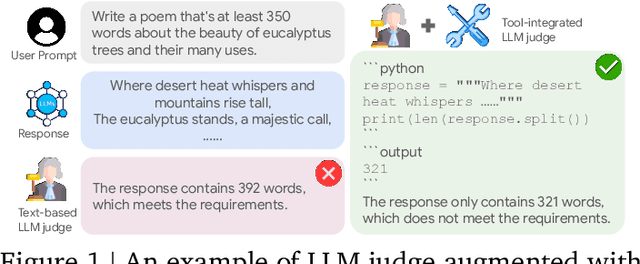
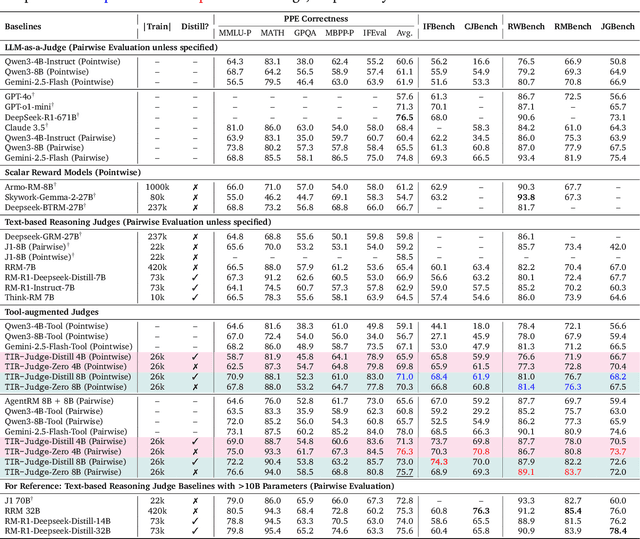
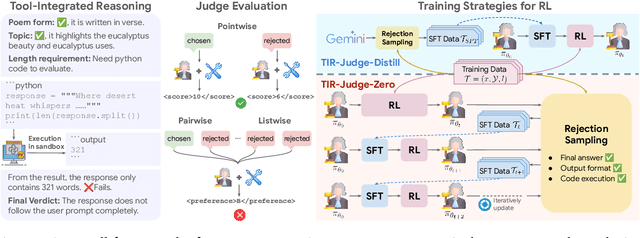
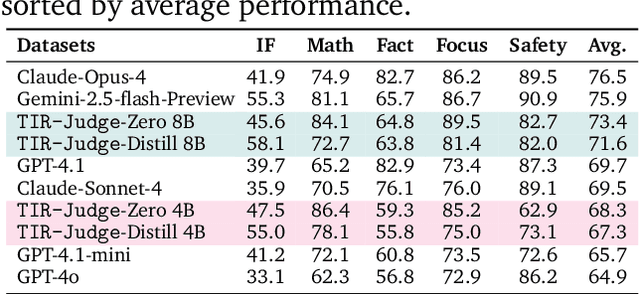
Large Language Models (LLMs) are widely used as judges to evaluate response quality, providing a scalable alternative to human evaluation. However, most LLM judges operate solely on intrinsic text-based reasoning, limiting their ability to verify complex constraints or perform accurate computation. Motivated by the success of tool-integrated reasoning (TIR) in numerous tasks, we propose TIR-Judge, an end-to-end RL framework for training LLM judges that integrates a code executor for precise evaluation. TIR-Judge is built on three principles: (i) diverse training across verifiable and non-verifiable domains, (ii) flexible judgment formats (pointwise, pairwise, listwise), and (iii) iterative RL that bootstraps directly from the initial model without distillation. On seven public benchmarks, TIR-Judge surpasses strong reasoning-based judges by up to 6.4% (pointwise) and 7.7% (pairwise), and achieves listwise performance comparable to Claude-Opus-4 despite having only 8B parameters. Remarkably, TIR-Judge-Zero - trained entirely without distilled judge trajectories, matches the performance of distilled variants, demonstrating that tool-augmented judges can self-evolve through iterative reinforcement learning.